
- Home
- / Topics
- / Brain and Body
Intuition: Meaning, benefits, and risks to remember
Reviewed by Brooks Baer, LCPC, CMHP

Written by
therapist.com teamLast updated: 08/31/2026
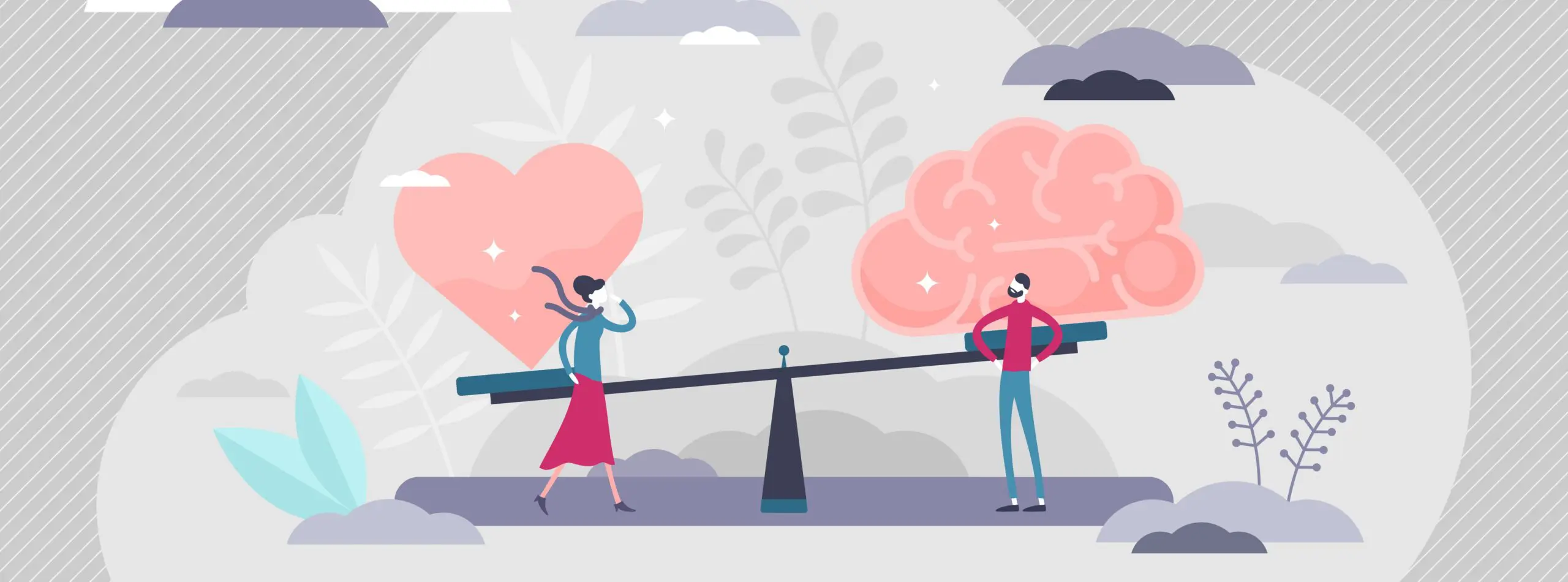
Have you ever had a strong feeling about something without knowing exactly why? Maybe you met someone new and immediately felt comfortable—or uncomfortable. Perhaps you sensed a friend was upset before they said a word. These moments are often your intuition at work.


Intuition can be a powerful guide, but it’s also shaped by your mental health and other factors. Understanding how they all connect can help you make better decisions and know when to trust gut feelings.
What is intuition, really?
Intuition is the ability to understand something immediately without conscious reasoning. It’s often described as a “gut feeling” about whether a person, place, or situation feels right or wrong.1
Intuition can feel like a magic trick, but it isn’t. It’s your brain working behind the scenes. Highly skilled “intuiters” can hold many patterns in their memory at once, along with information about how emotionally important each item is. This pattern recognition happens automatically, without you having to think about it.
Intuition also taps into the idea of “nonverbal decoding.” This means your responses often come from interpreting unspoken clues like:
- Facial expressions
- Tone of voice
- Body posture
- Eye contact
- Timing and rhythm of speech
- Gestures
Your brain may pick up on these signals, and form impressions about them, faster than you can consciously process.
What it feels like to use your intuition
Intuition is fast, automatic, and low-effort thinking.2 It’s the opposite of reflection, which involves slow, controlled, high-effort thought.
Intuition has several key features:3
- You have only dim awareness of how you reached your conclusion
- The process feels fast and effortless
- It happens without you trying to make it happen
- Your body generates internal, felt signals that help you process information
For example, imagine you’re deciding between two job offers. One pays more and “should” be more appealing, but something about it doesn’t feel right. You can’t explain why, but your gut is telling you to choose the other option. It may be that your brain has picked up on, and processed, subtle cues you haven’t consciously noticed yet.
Or consider walking into a room and immediately sensing tension, even though no one has said anything to imply things are off. Your intuition is likely reading body language, vocal tones, and other nonverbal signals to give you that gut feeling.
It’s important to note that in some cases what feels like intuition could actually be anxiety, depression, or another mental health concern informing your opinion.
The relationship between intuition, mental health, and decision-making is complicated. It can be helpful to work with a mental health professional to unpack your motivations and make sure you’re making values-based decisions about your life.
Benefits of using your intuition
Research on intuition is still developing. Studies on the topic are scattered across different fields like psychology, philosophy, and organizational science.4 However, evidence suggests that the ability can offer certain benefits.
- Improved decision-making in areas of expertise: When you have enough experience in a certain domain, intuition may lead to better, faster decisions.5 A classic example would be a veteran detective who can sense when someone’s story doesn’t add up or gets “a hunch” about a case.
- Improved creative problem-solving: It’s been proposed that intuition can play a key role in the “incubation” stage of creative breakthroughs. After someone does the hard work of studying or gathering knowledge, intuition may work in the background to process and combine the information. This can contribute to “aha” or breakthrough moments.
Are there risks to relying on intuition?
Leaning on your intuition can be healthy and practical in some ways, but it isn’t always reliable. Certain life experiences, mental health concerns, and other factors can deeply impact intuition. Here are some important factors to keep in mind.
Lack of expertise: Effective intuition requires domain-specific expertise built over approximately 10 or more years.6 Relying on gut feelings outside your area of knowledge can lead to poor decisions. As researchers note, intuition “rests on familiarity with the domain of knowledge.”
Anxiety can impair intuition: One study found that state anxiety specifically impairs the processes that make intuition work.7 When you’re anxious, your perception, memory, and reasoning abilities get weaker.8 This leads you to collect less information even while you rely more heavily on intuitive decision making. As a result, you make more intuitive but less accurate choices.
Depression undermines body trust: People with depression struggle to trust their own bodily signals.9 Since some researchers link intuition to the ability to interpret signals from your body, this raises the question of how deeply depression can interfere with intuitive processes.
Trauma can increase reliance on intuition: Posttraumatic stress sometimes pushes people toward more intuitive and shortcut-based decision-making rather than careful, analytical thinking.10 This can be problematic in situations that call for slow, logical decision making.
Ultimately, intuition works best as a complement to—not a replacement for—logical analysis. The strongest decisions often come from combining your gut instinct with facts, data, and deliberate reasoning. This is especially important in unfamiliar situations or when your mental health may be clouding your instincts.
If you’re struggling with anxiety, depression, or the effects of trauma, consider talking with a therapist. They can help you unpack your reasoning for decisions, identify patterns of thinking, and improve your overall mental health.
How to strengthen your intuition
Like any skill, your intuition can be developed through deliberate practice. Here are some techniques you can use to work on improving your intuitive abilities:
Meditation and breathwork: One study found that regular body scan and breath work practices helped participants tune into their bodies’ signals.11 This can be a way for people to become more aware of some of the physical sensations that support intuition.
Mindfulness-based approaches: Studies found that mindfulness programs focused on body awareness improved several aspects of “interoception,” your ability to notice and interpret signals from within your own body.12 Mindfulness training increased participants’ ability to self-regulate emotions, pay attention to bodily sensations, “listen” to the body, be aware of emotions, and trust their own body signals.
Online body awareness programs: Interventions focusing on progressive muscle relaxation, body functionality, emotion awareness, and hunger/fullness signals produced significant improvements in body awareness after three months.13
It’s important to know that mindfulness training can help how people feel about their body awareness, but doesn’t always improve the accuracy with which they interpret their body’s sensations.14 You might feel more connected to your body, but this doesn’t guarantee your gut feelings will be more accurate in all situations.
Seeking professional help
If you’re dealing with depression, anxiety, or trauma, your intuition may not be giving you reliable signals. This is when professional support can be especially helpful.
Consider reaching out to a mental health professional if:
- Your anxiety is making it hard to make decisions
- You find yourself second-guessing every gut instinct
- Depression is making you distrust your own body and instincts
- Past trauma is pushing you toward impulsive choices
- You’re struggling to tell the difference between intuition, fear, or other emotions
Remember that there’s no benchmark you need to reach to involve justifying a professional in your care. Working with a mental health professional can help you rebuild trust in yourself and develop healthier decision-making patterns. They can teach you skills to manage anxiety, process trauma, and reconnect with your body’s signals in a balanced way.
Ready to find support? Visit our therapist directory to connect with a licensed mental health professional.

Sources
1 https://pmc.ncbi.nlm.nih.gov/articles/PMC3218761/
2 https://link.springer.com/article/10.3758/s13428-022-01984-4
3 https://www.frontiersin.org/journals/psychology/articles/10.3389/fpsyg.2021.787428/full
4 https://pmc.ncbi.nlm.nih.gov/articles/PMC3218761/
5 https://pmc.ncbi.nlm.nih.gov/articles/PMC3218761/
6 https://pmc.ncbi.nlm.nih.gov/articles/PMC3218761/
7 https://journals.sagepub.com/doi/10.1177/2167702617728705
8 https://www.mdpi.com/1660-4601/20/2/1484/
9 https://www.sciencedirect.com/science/article/abs/pii/S0165032720331827/
10 https://www.frontiersin.org/journals/psychiatry/articles/10.3389/fpsyt.2023.1105662/full
11 https://www.frontiersin.org/journals/psychology/articles/10.3389/fpsyg.2014.01504/full
12 https://www.sciencedirect.com/science/article/abs/pii/S0022399917301393/
13 https://onlinelibrary.wiley.com/doi/10.1111/sltb.12994
14 https://www.sciencedirect.com/science/article/abs/pii/S0022399917301393/
About the author
The editorial team at therapist.com works with the world’s leading clinical experts to bring you accessible, insightful information about mental health topics and trends.
