
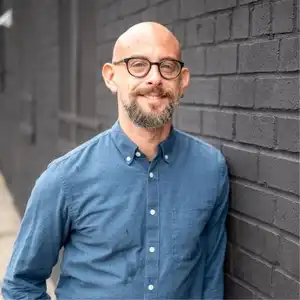
Andrew Titus, LCSW
Licensed Clinical Social Worker
Ocean Hill, NY
Online only
Free initial consultation
About me
I am a queer-affirming licensed clinical social worker dedicated to helping adults work through anxiety, depression, grief, identity, relationship patterns, and the particular weight of navigating a world that isn't always built for them.
Hi. I'm a licensed clinical social worker offering psychotherapy for adults. If you're here, you're probably trying to figure out whether I might be a good fit — so let me try to give you a real sense of who I am and how I work.
**My path to this work**
Mine was not a straight line. In my twenties and early thirties, I worked in hospitality and HIV prevention — roles that turned out to be surprisingly good training for clinical work. Both required attunement, quick situational reading, the ability to hold difficult conversations without flinching, and a working understanding of how stress, intimacy, and stigma operate in real people's lives. I was doing relational work long before I had language for it.
At 31, I returned to school and completed a bachelor's degree in anthropology. That education changed how I think — about culture, power, meaning-making, and the ways social context shapes individual experience. It gave me a framework for understanding people not just as individuals with symptoms, but as people embedded in histories, communities, and systems that matter clinically.
Therapy became the place where all of that converged: the relational attunement I developed early, the structural thinking I built in school, and a genuine interest in what it means to help someone move through their life with more clarity and less unnecessary suffering.
**How I work**
My approach is relational, which means I take seriously the connection between your history, your relationships, and the patterns showing up in your life right now. I don't think people are broken. I think people develop very intelligent adaptations to difficult circumstances, and that sometimes those adaptations outlive their usefulness. A lot of what we do together is understanding what you're working with, why it makes sense that you developed it, and what might be possible if you're ready to try something different.
I draw on a range of evidence-based approaches — Cognitive Behavioral Therapy (CBT), Dialectical Behavior Therapy (DBT), Internal Family Systems (IFS)-informed work, Interpersonal Therapy (IPT), and family systems thinking — but I'm not rigid about any of them. The framework is there to serve the work, not the other way around. I adapt what I use based on what actually fits you.
My style is warm and direct. I'll be honest with you, ask questions that are meant to actually open something up, and challenge you when that's useful. I'm not going to tell you what you want to hear, and I'm not going to stay neutral when neutrality would be unhelpful. I'll also be transparent about what I'm doing and why — I think you deserve to understand the work we're doing together, not just experience it.
I'm comfortable sitting with complexity. I don't rush to reassure when reassurance would be a shortcut, and I try not to over-pathologize. Most people I work with are doing the best they can with what they have. Understanding that doesn't mean we stop working toward something better — it just means we start from a place of honesty rather than judgment.
**What to expect**
Working with me is collaborative and intentional. The intake process is thorough — I want to understand what's bringing you in now, your history, and how patterns show up in your nervous system, your relationships, and your day-to-day life. We move at a pace that's actually workable, especially in a world that is often overstimulating and genuinely hard to navigate.
Progress tends to look like greater ease responding to stress, more clarity about what you're feeling and why, and more real choice in how you respond to the people and situations around you. I may occasionally invite some reading, reflective writing, or small practices between sessions — always collaboratively, never as homework dropped on you without discussion.
The therapeutic relationship itself — what happens between us in the room — is something I pay close attention to, because I believe it's one of the most important mechanisms of change. That includes the moments of difficulty: misunderstanding, disconnection, conflict. I don't avoid those. I think they're often where the most important work happens.
**What I work on**
I work with adults on a wide range of concerns. Much of my practice involves anxiety, depression, grief and loss, identity, queer experience, attachment, relationship patterns, family conflict, and relational rupture and repair. I also work with people navigating intrusive thoughts, body image concerns, substance use recovery, nonmonogamy and ethically non-traditional relationship structures, neurodivergence, and severe mental illness. I have particular experience with young adults working through identity formation and major life transitions, and with adults from religious or high-control backgrounds.
I work well with people who want to understand how early experiences shape present-day reactions, beliefs, and coping — people who have sometimes been told their responses are "too much" or don't make sense. They usually make a lot of sense once we look at the whole picture.
**A note on queer-affirming care**
I'm queer-affirming and actively engaged with LGBTQ+-informed clinical practice. I'm familiar with the particular textures of queer experience — the grief, the resilience, the complicated family histories, the community losses, and everything in between. I do my best not to require clients to orient me to who they are before the real work can begin. You shouldn't have to spend your therapy sessions educating your therapist.
**How I keep learning**
I think of learning as something that doesn't have a finish line. I stay engaged in ongoing training, consultation, and skill development — with particular attention to trauma-informed care, LGBTQ+ clinical practice, and how power, systems, and material conditions shape mental health in ways that don't always show up in a diagnostic manual.
I'm especially drawn to approaches that help people process overwhelming experiences, regulate stress responses, and understand how their history lives in the body — not just in thought patterns or behavior. I also learn through the work itself. Clients teach me things no training can, and I try to stay open to that. The balance between strong clinical grounding and genuine curiosity about each person in front of me is something I work to maintain. I want to bring rigorous, current practice — without losing sight of the real pressures people are living under or the actual limits of what any of us can control.
**Getting started**
If you're curious about reaching out and want to get a sense of whether we'd work well together, I'm happy to start with a consultation. No pressure, no commitment — just a conversation.
License
License(s)
Education
Silberman School of Social Work at Hunter College
Fees and insurance
Cost per session
$175 - $250Accepted payment methods
- Zelle
- Venmo
- Credit Card
- Flexible Spending Account (FSA)
Accepted credit cards
- Visa
- Mastercard
- American Express
- Discover
Accepted insurance plans
- United Healthcare
- Employee Assistance Program (EAP) Services
- Aetna
- Anthem
- Out of Network
- Cigna
- Blue Cross/Blue Shield
- Optum
Specialties and clinical interests
- ADHD
- Anger Issues
- Betrayal Trauma
- Bullying
- Career
- Chronic Illness
- Depression
- Divorce & Separation
- Domestic Abuse/Violence
- Family Conflict
- Gender Identity
- Grief & Loss
- Highly Sensitive Persons (HSPs)
- LGBTQIA+
- Men's Issues
- Mental Health Professionals
- Race-Based Traumatic Stress (RBTS)
- Relationships
- Self-Esteem
- Sexual Abuse
- Sexual Identity
- Spirituality
- Stress/Stress Management
- Trauma & PTSD
Therapy types
- Client-Centered Therapy
- Cognitive Behavioral Therapy (CBT)
- Dialectical Behavior Therapy (DBT)
- Internal Family Systems (IFS)
- Mindfulness
- Solution-Focused Brief Therapy (SFBT)
- Trauma-Informed Therapy
Community specialties
- LGBTQIA+
- Autism
- 12-Step Programs
- Hispanic or Latino
- Biracial
- HIV / AIDS
- Trauma Survivors
Faith-based specialties
- Atheism/Agnosticism
- Buddhism
- Recovery from High Control Religions
Licensed to see clients in
Years in practice
Service types
- Therapy / Counseling
Types of clients
- Adults (18+)
- Older Adults (65+)
- Individuals
- Parents & Caregivers
Languages
- English
Website and social media